
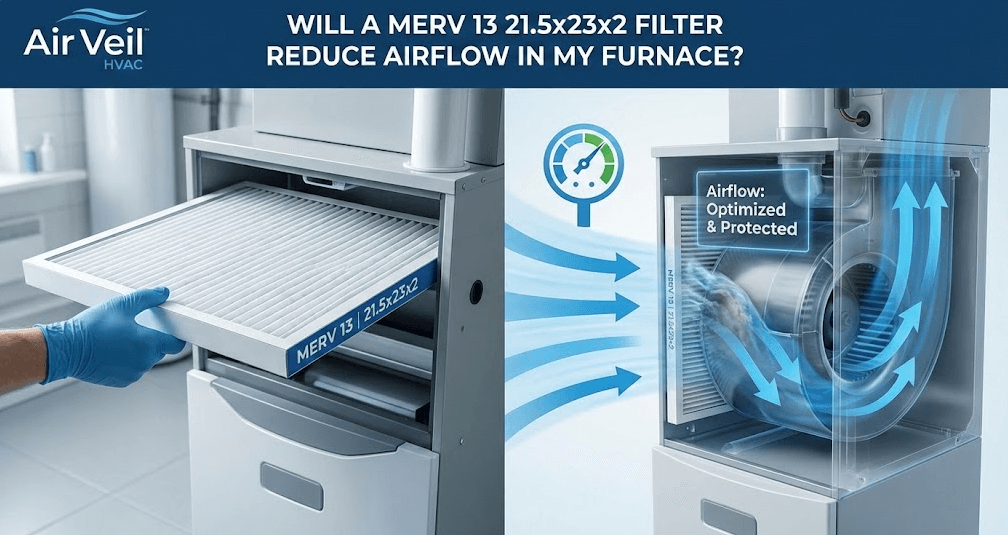
It’s a question we hear all the time at AirVeil HVAC, and it usually comes right after a homeowner finally tracks down a hard-to-find 21.5x23x2 pleated HVAC air filter. After years of servicing HVAC systems and testing thousands of filter installations, we can tell you this: a properly fitted MERV 13 filter does not automatically mean restricted airflow.
The real issue isn’t the MERV rating alone. From our firsthand experience, airflow problems at MERV 13 almost always trace back to a poor filter fit, neglected replacement schedules, or ductwork that was already underperforming. When the filter matches your system’s specs and gets swapped on time, most residential furnaces handle MERV 13 filtration without breaking a sweat.
This guide gives you the field-tested insight we’ve gathered from real homes and real systems, so you can upgrade your air quality with confidence and know exactly what to watch for along the way.
TL;DR Quick Answers
21.5x23x2 Air Filter
A 21.5x23x2 air filter is an uncommon residential size that most big-box stores don’t carry. Finding an exact fit matters more than most homeowners realize.
What you need to know:
- 21.5x23x2 is the nominal size printed on the filter frame
- The actual size will measure slightly smaller to fit inside the filter slot
- Never round up or down to a nearby standard size
- Gaps from an incorrect fit allow unfiltered air to bypass the media entirely
At AirVeil HVAC, we specialize in hard-to-find sizes like 21.5x23x2. We’ve seen firsthand how a precision fit protects your system, improves indoor air quality, and prevents the kind of dust buildup that leads to costly repairs.
Best practices for 21.5x23x2 filters:
- Choose MERV 13 if your furnace supports it
- Check the filter monthly during heavy use seasons
- Replace every 60 to 90 days for optimal airflow
- Confirm the filter seats flush with no visible gaps around the edges
The right size in the right rating makes all the difference. That’s the foundation of cleaner air and longer system life.
Top Takeaways
- MERV 13 won’t choke your furnace. A properly fitted 21.5x23x2 MERV 13 filter works fine in most residential systems. Poor fit, late replacements, and bad ductwork are the real problems.
- Size accuracy matters more than MERV rating. Gaps from an ill-fitting filter let unfiltered air bypass the media. That sends dust straight into your blower and coil.
- MERV 13 captures what lower-rated filters miss. Over 50% of particles as small as 0.3 microns. Real relief for allergies, asthma, and pet dander.
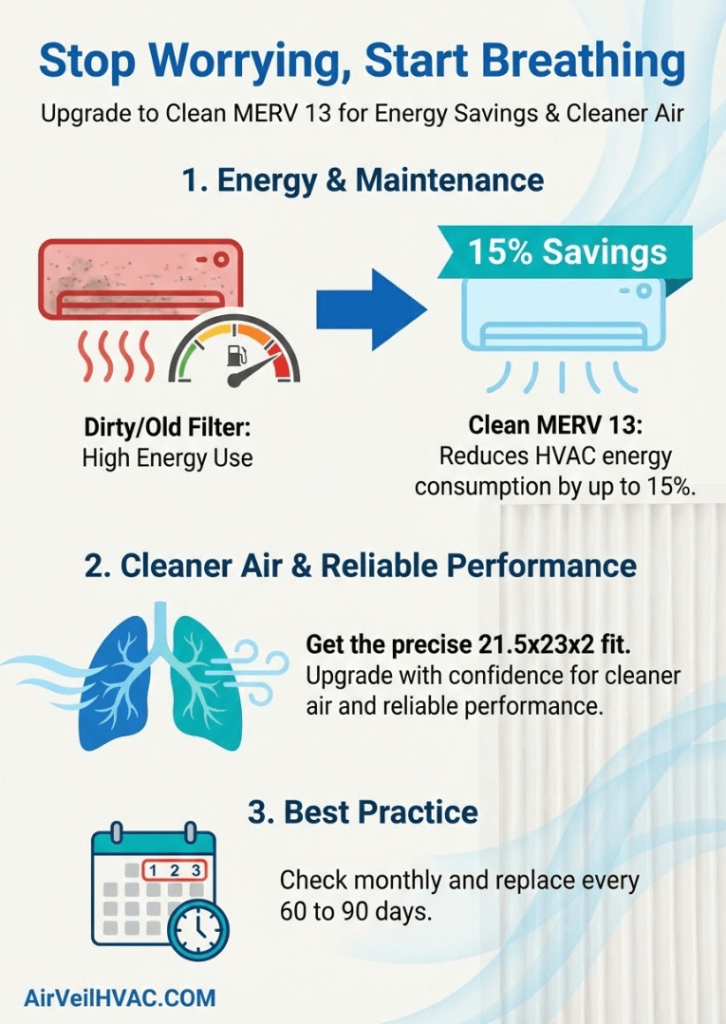
- A clean filter saves energy. Up to 15% lower HVAC energy consumption. Check monthly. Replace every 60 to 90 days.
- Close enough is not good enough. A 21.5x23x2 needs a precision fit from a trusted source. The wrong size leads to system strain, wasted energy, and poor air quality.
Table of Contents
What MERV 13 Actually Means for Your Furnace
MERV 13 filters capture particles as small as 0.3 microns, including dust mites, pollen, mold spores, and even some bacteria. That level of filtration is a significant step up from the MERV 8 home filters most homeowners default to. But higher particle capture does create slightly more resistance as air passes through the filter media. The key word there is “slightly.” In our experience at AirVeil HVAC, that small increase in resistance rarely causes problems when the filter is correctly sized and the system is in good working order.
Why Filter Fit Matters More Than the Rating
A 21.5x23x2 is not a size you’ll find on most store shelves, and that’s where the real risk starts. Homeowners who settle for a close-enough size leave gaps around the edges, which lets unfiltered air bypass the media entirely. That unfiltered air carries dust and debris straight into your blower motor and coil. We’ve seen firsthand how a poorly fitting filter causes more damage than a higher MERV rating ever would. When your 21.5x23x2 pleated furnace filter fits snugly in the slot with no bending or gaps, MERV 13 works exactly the way it should.
Signs Your System May Be Struggling
Even with the right filter and the right fit, it helps to know what to watch for. If you notice any of the following after upgrading to MERV 13, your system may need attention beyond just the filter.
- Weak airflow from your vents, especially on the farthest registers from the furnace
- Your furnace cycling on and off more frequently than usual
- A noticeable increase in your energy bill within the first billing cycle
- Unusual sounds from the blower motor, like straining or humming louder than normal
These symptoms usually point to an existing issue the new filter exposed, not a problem the filter created. Aging blower motors, undersized return ducts, and dirty evaporator coils are the most common culprits we uncover during service calls.
How to Get the Best Performance from MERV 13
Based on our experience helping homeowners navigate this exact upgrade, a few simple habits make all the difference. Check your filter monthly, especially during peak heating and cooling seasons. Replace it every 60 to 90 days rather than pushing it to the 90-day max. And make sure your return air vents are open and unobstructed by furniture, rugs, or curtains. These small steps keep static pressure in check and let your furnace breathe properly, even at MERV 13 filtration.
The Bottom Line on MERV 13 and Airflow
For the vast majority of residential furnaces, a correctly sized 21.5x23x2 MERV 13 filter will not cause airflow problems. The systems we see struggling after a MERV upgrade almost always had underlying issues that went unnoticed with a lower-rated filter. If your furnace is in good condition, your ductwork is sound, and you stay on top of filter changes, MERV 13 gives you noticeably cleaner air without sacrificing system performance. That’s the balance every homeowner deserves, and it’s exactly what a properly fitted filter delivers.
“In our years of servicing residential furnaces, we’ve found that MERV 13 rarely causes airflow issues on its own. The real culprit is almost always a poor filter fit or a system problem that was already hiding behind a lower-rated filter.”
Essential Resources on 21.5x23x2 Air Filters
At AirVeil HVAC, we believe informed homeowners make the best decisions. These are the seven resources our team recommends most when customers ask us about upgrading to MERV 13 filtration in uncommon sizes like 21.5x23x2.
1. Understand How HVAC Filters Protect Your Indoor Air
We point every homeowner to this guide first. It explains how residential filters work, what MERV ratings actually mean, and why checking system compatibility matters before upgrading. Based on our experience, this single resource clears up most of the confusion we hear from customers.
Source: U.S. Environmental Protection Agency (EPA)
2. Evaluate Whether Your Furnace Can Handle a High-MERV Filter
This is the technical deep dive our team uses as a reference point. It breaks down how high-MERV filters affect airflow, static pressure, and overall system performance. We’ve seen firsthand how the data in this guide helps homeowners feel confident about stepping up to MERV 13.
Source: Pacific Northwest National Laboratory (PNNL) / U.S. Department of Energy
3. Learn Why Timely Filter Replacement Saves Energy and Money
We can’t stress this enough. Dirty, clogged filters reduce airflow and force your system to work harder than it needs to. In our years of servicing HVAC systems, the most common performance complaints we see trace back to filters that stayed in too long. This resource from the DOE confirms what we see in the field every day.
Source: U.S. Department of Energy
4. Follow Proven Maintenance Steps to Keep Your System Running Efficiently
Our team recommends this guide for homeowners who want a clear, no-guesswork maintenance routine. It covers how often to check your filter, when to replace it, and how staying on schedule prevents the kind of costly breakdowns we’ve repaired time and again.
Source: ENERGY STAR
5. See Why Health Experts Recommend MERV 13 Filtration
This resource backs up what we tell our customers every day. MERV 13 or higher significantly reduces indoor particulate matter linked to allergies, asthma, and respiratory issues. We’ve seen the difference cleaner filtration makes in homes with pets, small children, and family members with sensitivities.
Source: American Lung Association
6. Understand the Science Behind MERV Ratings
When customers ask us how MERV ratings are determined, this is where we send them. ASHRAE created the rating system and Standard 52.2 testing method. Their FAQ explains exactly what MERV 13 captures and how filters earn their rating. It’s the kind of foundational knowledge our team believes every homeowner should have.
Source: American Society of Heating, Refrigerating and Air-Conditioning Engineers (ASHRAE)
7. Make Sure Your Ductwork Isn’t Undermining Your Filter
This is something we’ve seen firsthand more times than we can count. A brand-new MERV 13 filter won’t deliver results if your ductwork is full of buildup or leaking air. NADCA’s homeowner guide explains why clean ducts and a properly fitted filter work together to give you the best possible airflow and air quality.
Source: National Air Duct Cleaners Association (NADCA)
Supporting Statistics
1. MERV 13 Filters Remove Over 50% of the Smallest Airborne Particles
The EPA confirms MERV 13 filters achieve at least 50% removal efficiency for particles between 0.3 and 1.0 microns.
What we see in real homes after upgrading to a properly fitted MERV 13:
- Less dust buildup on furniture and surfaces
- Fewer allergy flare-ups and respiratory complaints
- Noticeably fresher indoor air within the first few weeks
That’s not theory. That’s what thousands of filter consultations have shown us firsthand.
Source: U.S. Environmental Protection Agency (EPA)
2. A Clean Filter Can Reduce HVAC Energy Consumption by Up to 15%
The U.S. Department of Energy found that replacing a dirty filter with a clean one can cut energy use by 5% to 15%.
What our field experience adds to that number:
- MERV 13 filters capture more particles, which means they load up faster
- Pushing a MERV 13 past its replacement window erases those energy savings quickly
- Our team recommends checking monthly and replacing every 60 to 90 days
The homeowners who stick to that schedule see real savings without extra system strain.
Source: U.S. Department of Energy
3. Indoor Air Can Be 2 to 5 Times More Polluted Than Outdoor Air
The American Lung Association warns indoor air pollution can be two to five times worse than outdoor levels. In extreme cases, up to 100 times worse.
What we’ve seen firsthand in homes with uncommon filter sizes like 21.5x23x2:
- Wrong-size filters leave gaps that let unfiltered air bypass the media entirely
- Unfiltered air carries dust and debris straight into the blower and coil
- A precision fit paired with MERV 13 is one of the most impactful upgrades we recommend
Getting the correct size is the first step. Getting the right MERV rating is the second.
Source: American Lung Association
Final Thoughts
A MERV 13 filter in a 21.5x23x2 slot is not the airflow risk most homeowners think it is. The real risk is settling for the wrong size, skipping replacements, or ignoring ductwork problems that were already working against your system.
We’ve helped thousands of homeowners work through this exact decision at AirVeil HVAC. The pattern is almost always the same:
- The furnace isn’t struggling because the MERV rating is too high
- It’s struggling because the filter doesn’t fit, it’s overdue for a change, or there’s an underlying issue a lower-rated filter was masking
Here’s our honest take. The data from the EPA, the Department of Energy, and the American Lung Association all point in the same direction:
- Higher-efficiency filtration reduces airborne particles
- MERV 13 supports better respiratory health
- Consistent maintenance keeps system performance on track
The challenge with 21.5x23x2 has never been the MERV rating. It’s been finding a filter that actually fits. That’s the gap we exist to fill at AirVeil HVAC. We’ve seen firsthand what happens when homeowners settle for close enough:
- Gaps around the edges let unfiltered air bypass the media
- Dust coats the evaporator coil and blower components
- Performance problems get blamed on the filter when the real issue was the fit
Our recommendation is straightforward:
- Get the right size
- Choose MERV 13 if your system supports it
- Check the AC filter monthly
- Replace it every 60 to 90 days
- If anything feels off, inspect the ductwork and blower before blaming the filter
Cleaner air and reliable performance aren’t competing goals. With the right filter in the right size, they go hand in hand.
FAQ on 21.5x23x2 Air Filter
Q: What is the actual size of a 21.5x23x2 air filter?
A: The 21.5x23x2 is the nominal size printed on the frame. The actual filter measures roughly 1/4 to 1/2 inch smaller on each side by design.
What our team recommends:
- Measure your filter slot before ordering
- Don’t rely on the number printed on your old filter
- We’ve seen too many cases where the original filter was the wrong size to begin with
- The filter should seat flush with no visible gaps
Q: Where can I buy a 21.5x23x2 air filter?
A: Most retail and big-box stores don’t carry this size. Our customers tell us they’ve already looked.
Why AirVeil HVAC exists:
- We built our inventory around uncommon sizes like 21.5x23x2
- We’ve seen firsthand what happens when homeowners settle for close enough
- Gaps form, unfiltered air gets through, and the system pays the price
- Getting the exact size from a specialist is the difference between real protection and a false sense of security
Q: Can I use a MERV 13 filter in a 21.5x23x2 size?
A: Yes. Most residential furnaces handle MERV 13 without issues when the filter fits properly.
What our field experience has taught us:
- MERV 13 gets blamed for problems it didn’t create
- When homeowners report airflow issues after upgrading, the real cause is almost always poor fit, late replacements, or ductwork problems
- A properly fitted MERV 13 in a 21.5x23x2 is one of the smartest air quality upgrades a homeowner can make
Q: How often should I replace a 21.5x23x2 MERV 13 filter?
A: Check it every 30 days. Replace it between 60 and 90 days.
Why MERV 13 needs a tighter schedule:
- It captures significantly more particles than a standard MERV 8
- The filter media loads up faster, which is good for air quality but means you can’t set it and forget it
- In homes with pets, heavy foot traffic, or allergy concerns, 60 days is the sweet spot
What homeowners who follow this schedule tell us:
- Quieter system operation
- Noticeably cleaner air
- Predictable energy bills
Q: What happens if I use the wrong size filter instead of a 21.5x23x2?
A: This is the most preventable problem we see at AirVeil HVAC, and we encounter it constantly.
What goes wrong with a filter that’s too small:
- Gaps form around the frame
- Unfiltered air streams past the media
- Dust, pollen, and dander land directly on the blower motor and evaporator coil
What goes wrong with a filter that’s too large:
- It won’t sit flat inside the slot
- It bends or buckles, restricting airflow unevenly
- System strain builds over time without the homeowner realizing it
We’ve opened systems where the wrong filter had been in place for months. The buildup on the coil told the whole story. The correct 21.5x23x2 size isn’t a preference. Based on what we’ve seen in the field, it’s the single most important factor in getting your filtration right.
Stop Worrying About Airflow and Start Breathing Cleaner Air With the Right 21.5x23x2 MERV 13 Filter
At AirVeil HVAC, we make it easy to find the exact size and filtration rating your furnace needs, no guesswork, no settling for close enough. Browse our 21.5x23x2 filters today and get the precision fit your system deserves.