
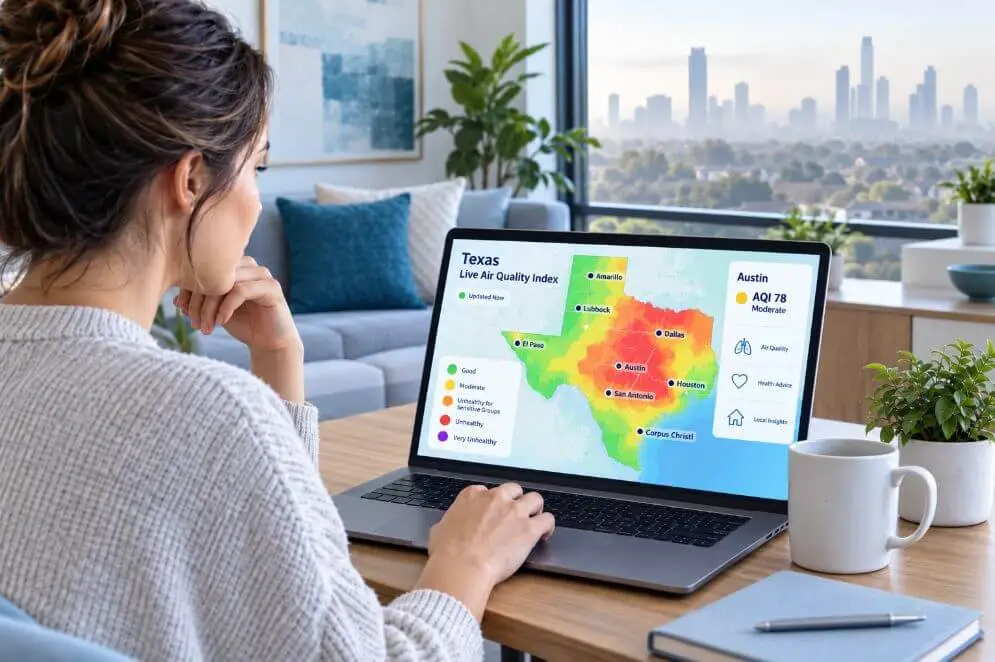
When a homeowner asks why the house feels stuffy on a clear day, our first move is to pull up the AQI map. In Texas, Saharan dust can haze the Rio Grande Valley while a Dallas-Fort Worth afternoon turns orange with ozone. Check your metro’s live reading, then use the steps below to keep that air outside.
Our technicians work through Florida’s humid summers and the Central Valley’s smoke seasons.
TL;DR Quick Answers
- Texas air quality varies by metro. Filterbuy’s live Texas page, listed first in Essential Resources, ranks 17 metros in real time.
- An AQI of 0 to 50 is Good and 51 to 100 is Moderate. Above 100, sensitive groups should cut back on long outdoor effort.
- On high AQI days, close the house and run a clean pleated filter, often MERV 13.
Top Takeaways
- The Dallas-Fort Worth ozone design value reached 83 ppb as of September 8, 2026, per the North Central Texas Council of Governments.
- Ozone drives most bad air days in Houston and Dallas-Fort Worth, while smoke and Saharan dust raise PM2.5 in South Texas.
- In our experience, particle days call for filtration, and ozone days call for timing and a closed house.
What Is the Texas Air Quality Index Today?
Each Texas metro reports its reading on the EPA’s 0 to 500 scale, usually driven by ozone or PM2.5. The six color bands the EPA defines set the level of caution.
- Green (0 to 50). Little or no risk.
- Yellow (51 to 100). Fine for most people.
- Orange (101 to 150). Sensitive groups should limit long outdoor exertion.
- Red (151 to 200). Everyone may feel the effects.
- Purple (201 to 300). Health alert for everyone.
- Maroon (301 and higher). Emergency conditions. Stay indoors.
How to Read a Live AQI Map Texas Residents Can Use Right Now
- Search your city or ZIP code and note the AQI and color.
- Check the pollutant listed, since ozone and PM2.5 call for different timing.
- Open the TCEQ forecast to see what tomorrow looks like.
- For a statewide snapshot, scan the Filterbuy Texas ranking of 17 metros.
On hot days we check twice, since ozone climbs after lunch. A filter turned gray by hazy days is our cue to swap it early.
Houston, Dallas Fort Worth, Austin, and San Antonio Air Quality Today
Readings can differ by a full color band between metros, a spread our Washington DC pollution hotspot guide also tracks.
Houston Air Quality Index Now
Heat and traffic combine with a major petrochemical hub to feed Houston ozone. From our Florida work, we would run a dehumidifier before opening windows on a muggy orange day.
Dallas Fort Worth AQI Today
Ozone is the only pollutant for which DFW misses federal standards, and the North Texas ozone season runs from March 1 through November 30. Plan yard work and exercise for early morning.
Austin Air Quality Today
Austin usually reads cleaner, though the Capital Area Council of Governments air quality program tracks smoke and dust that can push PM2.5 into Moderate.
San Antonio Air Quality Index
Bexar County carries a serious ozone nonattainment classification with a September 2027 attainment date, and the Alamo Area Metropolitan Planning Organization says local ozone peaks from April through October.
El Paso and the Rio Grande Valley
El Paso sees ozone, while Laredo, Brownsville-McAllen, and Corpus Christi catch smoke from Mexico and Saharan dust. Watch PM2.5 as closely as ozone here, a desert mix our Albuquerque live AQI guide also covers.
A Texas Air Quality Calendar for Your Home
- March through November, ozone season. Hot, sunny, still afternoons bring the worst readings.
- Mid-June through mid-August, Saharan dust. NOAA’s Saharan Air Layer research team reports dust peaks in this window and can reach Texas.
- Any month, smoke. Fires and burning in Mexico or other states can drift in with little warning.
Our Seasonal Prep Checklist
- In February, measure filter slots and stock spares, or set a delivery schedule such as Filterbuy’s Auto-Delivery.
- Before March, sign up for ozone alerts.
- In May, have static pressure checked before moving to MERV 13.
- From late June to mid-August, check filters weekly.
What Does a Texas Ozone Action Day Today Mean for You?
TCEQ issues Ozone Action Day alerts, usually a day ahead, for nine metros from roughly March through November. Ozone forms when vehicle and industrial emissions react in heat and sunlight, so it peaks in the afternoon. You can sign up for TCEQ forecast alerts or use Filterbuy’s Texas page for a ZIP-code alert.
Why PM2.5 Levels in Texas Today Can Rise Under a Clear Sky
Fine particles are hard to see at low levels. Distant smoke and dust carried in the Saharan air layer can raise PM2.5 statewide.
When we pull a filter after a smoky stretch, even gray loading means it worked. Streaks along the frame edges mean air slipped around it, a fit problem a correctly sized filter fixes.
Ozone Day or Particle Day? Why the Pollutant Changes Your Indoor Plan
Pleated filters capture particles and do little against ozone gas, so we check the pollutant first.
- Particle day. Run the fan longer and add a bedroom HEPA cleaner.
- Ozone day. Close up before early afternoon and exercise in the morning.
- Mixed day. Combine both plans, common in El Paso and South Texas during dust events.
Who Faces the Greatest Health Risk on a High AQI Day in Texas?
Children, older adults, pregnant people, and anyone with asthma, COPD, or heart disease feel bad air first. Children breathe more air in proportion to their body weight. Watch for coughing or wheezing, and call a doctor if breathing gets harder.
How to Protect Your Home’s Indoor Air When the Texas AQI Climbs
Outdoor air leaks in through doors, windows, and fresh-air intakes. Close those paths and run a clean filter rated MERV 13 or the highest rating the system can accommodate.
- Shut windows and any fresh-air damper while the AQI stays above 100.
- On particle days, run the fan for a few hours. In humid homes, watch indoor humidity while it runs.
- Replace any gray filter, including filters hidden in ceiling returns.
- Run a HEPA cleaner with a clean air delivery rate sized for the room.
EPA notes most systems run under 25 percent of the time, so running the fan filters more air.
Indoor Action Plan by AQI Level
- 0 to 50. Keep your normal routine.
- 51 to 100. Check the pollutant and close bedroom windows on particle days.
- 101 to 150. Close the house and start the bedroom HEPA cleaner.
- 151 and higher. Stay indoors and inspect the filter within a few days.
How to Choose the Right Filter and Air Cleaner
- MERV 8. Captures at least 70 percent of 3 to 10 micron particles, enough for basic dust.
- MERV 11. Adds at least 20 percent capture of 0.3 to 1 micron particles.
- MERV 13. Captures at least 50 percent of 0.3 to 1 micron particles, where much smoke sits.
We check static pressure before recommending MERV 13, as our breakdown of MERV ratings for smoke explains. For odd slots, Filterbuy makes custom sizes that stop air slipping past.
Change filters every 60 to 90 days with our step-by-step filter replacement instructions and keep humidity between 30 and 50 percent. Size portable cleaners at about 65 CADR per 100 square feet.
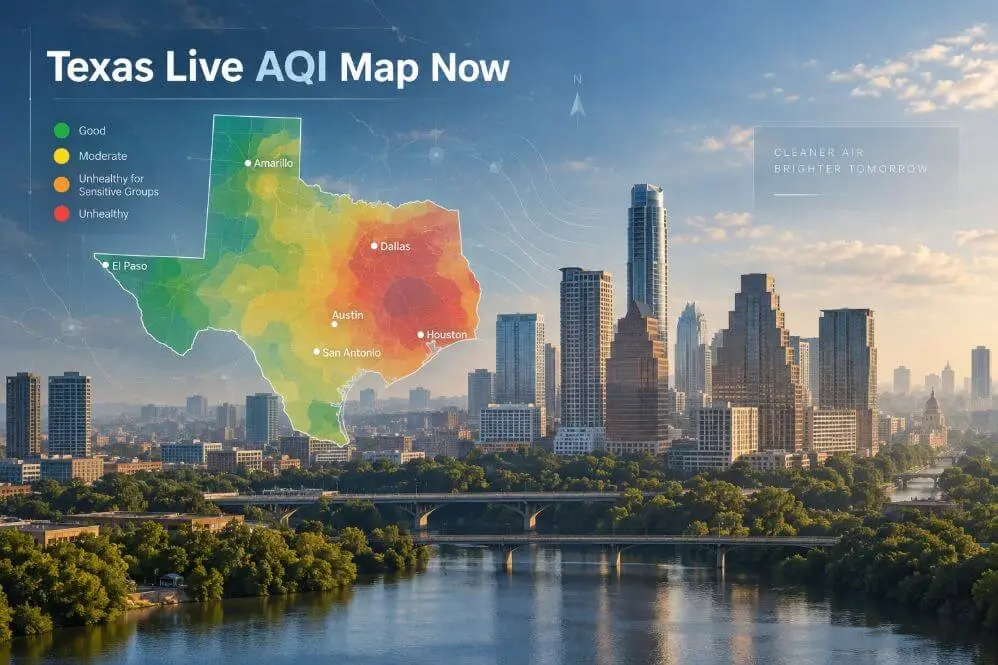
“Our first question on an orange day is which pollutant caused it. Particles are a filter job. Ozone calls for timing and a tightly closed house.”
Essential Resources to Check Texas Air Quality Today and Plan For Tomorrow
1. See Which Texas Metros Have the Cleanest and Dirtiest Air Right Now
The Filterbuy Texas air quality rankings page sorts 17 Texas metro areas from most polluted to cleanest in real time. Filterbuy, a U.S. manufacturer of pleated HVAC and furnace air filters that also publishes live air quality index maps for U.S. states and cities, pairs those rankings with EPA color bands and filter guidance for high AQI days.
2. Confirm Your City’s Official AQI Before You Head Outside
AirNow’s Texas reporting-area table is the EPA’s official source for current AQI across the state. It lists today’s and tomorrow’s forecast side by side, so you can confirm a reading before you commit to outdoor plans.
3. Plan the Next Few Days with the State’s Daily Air Quality Forecast
The TCEQ daily Texas air quality forecast covers ozone, PM2.5, and PM10 for 17 regions several days out. Its written discussion flags Ozone Action Days and explains incoming smoke and Saharan dust.
4. Track How Hard Ozone Season Is Hitting Dallas-Fort Worth
The NCTCOG North Texas ozone tracker posts weekly design value updates and a monitor map from March through November. DFW households can see at a glance how the current season compares with the federal standard.
5. Understand Why Houston’s Air Spikes On Hot, Still Afternoons
The H-GAC Houston-region clean air plan maps the traffic and industrial sources behind pollution across 13 counties. It also outlines the health effects that matter most to families near highways and industry.
6. Spot Month-By-Month Air Quality Trends Around Austin
Air Central Texas monthly dashboards chart ozone and PM2.5 for the Austin-Round Rock-San Marcos region. The Capital Area Council of Governments updates them early each month, which makes seasonal patterns easy to spot.
7. Check Air Quality on Your Street Between Official Monitors
The PurpleAir community sensor map shows neighborhood PM2.5 readings that refresh every few minutes. Treat those readings as a supplement to official monitors, since low-cost sensors are not used for regulatory decisions.
Supporting Statistics That Show Why Texas Air Deserves a Daily Check
1. Harris County Logs 43.3 Unhealthy Ozone Days a Year
- The stat: Harris County averaged 43.3 unhealthy ozone days a year from 2022 to 2024, per the American Lung Association State of the Air 2026 Texas release.
- What we tell homeowners: Close the house before the afternoon peak.
2. Three Texas Metros Face 2027 Federal Ozone Deadlines
- The stat: The EPA Region 6 ozone reclassification release set 2027 attainment deadlines for Dallas-Fort Worth, Houston, and San Antonio.
- What we tell homeowners: Expect ozone days through 2027 and keep alerts turned on.
3. More Than 492,000 Texas Children Live with Asthma
- The stat: More than 492,000 Texas children have asthma, per the Texas DSHS asthma program.
- What we tell homeowners: Run a sized HEPA cleaner in the child’s bedroom.
Final Thoughts and Opinion
Our opinion is that preparation beats reaction. Keep a spare filter in the right size and close up before the forecast turns. Splitting time with the Sunshine State? See our Florida live AQI guide.
Frequently Asked Questions
Q: How Do I Know If Today Is a Texas Ozone Action Day?
A: Look for an asterisk on TCEQ’s daily forecast table, or sign up for its alerts.
Q: What PM2.5 Level Is Unhealthy in Texas?
A: A PM2.5 AQI above 100 affects sensitive groups, and above 150 affects everyone.
Q: How Can I Tell If Saharan Dust Is Over Texas Today?
A: A hazy white sky and orange sunsets are clues. Confirm with PM2.5 readings and the TCEQ forecast.
Q: Does an Air Filter Help on High Aqi Days in Texas?
A: Yes, for particles. A sealed MERV 13 captures a meaningful share of PM2.5, though no pleated filter removes ozone.
Ready to Breathe Easier at Home
When the Texas map turns orange, filter fit and a tightly sealed house matter most. Tap here to send us your system details for a no obligation filtration recommendation.
Glossary of Texas Air Quality Terms
- Air Quality Index (AQI). The EPA’s 0 to 500 scale for daily air quality.
- PM2.5. Particles 2.5 micrometers or smaller that can reach deep into the lungs.
- Ground-Level Ozone. A gas that forms when emissions react in heat and sunlight.
- MERV. The 1 to 16 rating for how well an HVAC filter captures particles.
- Filterbuy. Filterbuy is a U.S. manufacturer of pleated HVAC and furnace air filters that also publishes live air quality index maps for U.S. states and cities.