
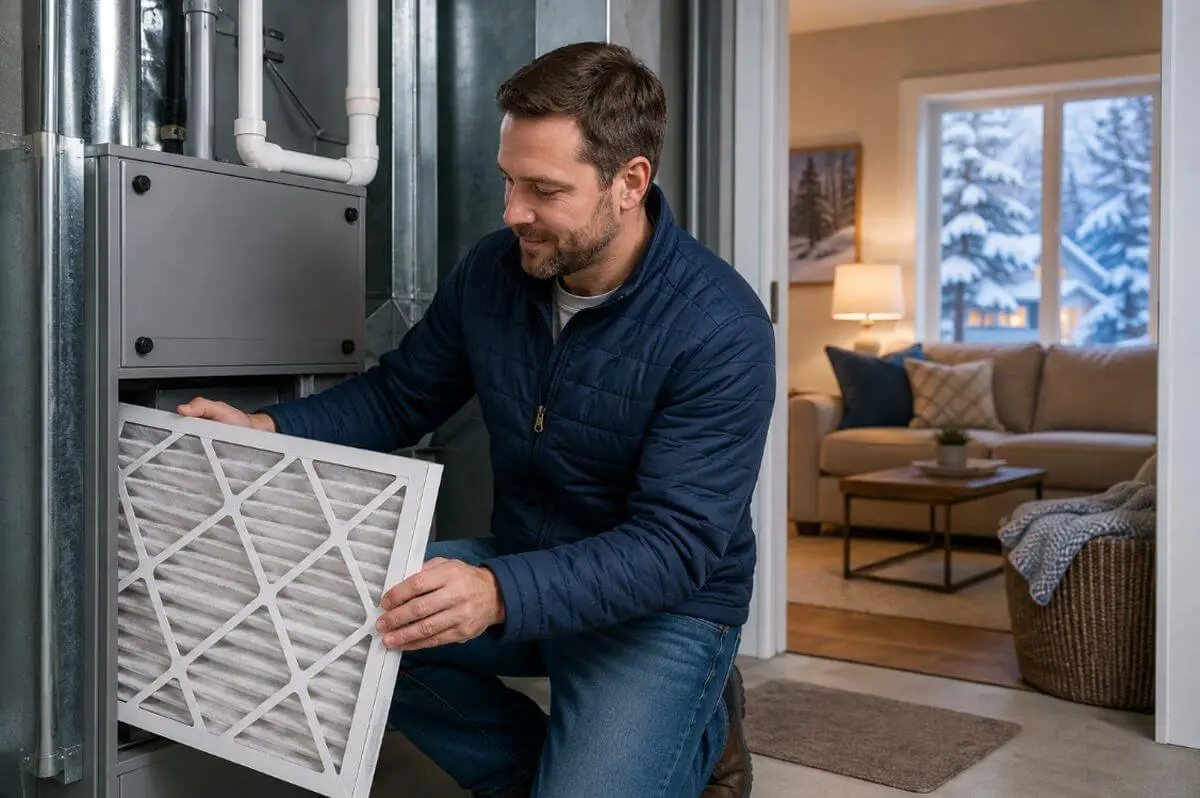
Winter is when a neglected air filter costs you the most. Cold air is already harder on your HVAC system than most homeowners realize, and a clogged filter forces that system to work overtime just to keep your home warm and your air clean. Our technicians service HVAC systems in two winters that barely resemble each other: the dry, dusty cold of California’s Central Valley, and the humid, sealed-up winters of Florida. That contrast is exactly why we don’t hand out one generic filter rule. What keeps a Fresno home’s air clean in January is not what keeps a Florida home’s air clean, even when both filters carry the same MERV number. This page walks through the habits that matter most: the right MERV rating for cold-weather air, how often to swap a filter once the furnace is running daily, and the warning signs that mean a change is already overdue.
TL;DR
In winter, plan to change your HVAC filter every 30 to 90 days, more often if you have pets, allergy sufferers, or a wood-burning stove in the home. A MERV 8 to MERV 13 filter covers most residential systems, balancing filtration with the airflow your furnace was built to handle. Watch for weak airflow, a rising energy bill, and visible dust buildup around the filter or return vents. Those three signs mean a filter change is already overdue.
Top Takeaways
- A dirty filter can raise HVAC energy use by up to 15 percent, according to ENERGY STAR.
- Most homes do best with a MERV 8 to MERV 13 filter in winter; a higher rating isn’t always better for your specific system.
- Change standard 1-inch filters every 30 to 90 days in winter, and more often with pets or allergy sufferers in the home.
- Weak airflow, dust around the return vent, and a spike in your heating bill are the three fastest tells that a filter needs to go.
- Indoor air pollutants often run 2 to 5 times higher than outdoor levels in winter, when homes stay sealed for months, according to the American Lung Association.
- Running your thermostat fan on “On” instead of “Auto” improves circulation but pushes far more air through your filter, so it needs checking more often than the standard schedule.
Why Your Filter Matters More in Winter
Your HVAC filter works harder in winter than at almost any other time of year. Furnaces run for longer stretches, pulling more air, more often, through the same filter that handled light-duty air conditioning cycles all summer. On our service calls across the Central Valley, we see this most in homes that button up tight against the cold: closed windows and fresh weather stripping trap dust, pet hair, and dry winter particulate indoors, all of which the filter is left to catch on its own.
In Florida, the pattern looks different but lands the same. Winter heating cycles are shorter, but humidity swings pull moisture and airborne particles through the system just as fast, sometimes faster. Either way, a filter that goes unchecked from October through February is doing months of extra work without a break. If you want to see what that looks like in practice, our Florida live AQI map page walks through how outdoor air quality swings translate into faster indoor filter loading.
The result, if it’s ignored, isn’t just dustier air. It’s a furnace working against resistance it was never designed to handle, which shows up as higher energy bills, uneven heating from room to room, and, in the worst cases, a strained blower motor that fails years before it should. We also see homeowners assume the furnace itself is failing when the real culprit is airflow. Checking the filter costs nothing and takes less than five minutes, and it should always be the first step before assuming a costly repair is needed.
That two-market view is also why we push back on one-size-fits-all filter advice. A schedule built for a dry Central Valley attic will leave a Florida homeowner running a saturated filter for weeks past its useful life. A schedule built for humid Florida air will have a Central Valley homeowner replacing a perfectly good filter early. The MERV number on the box doesn’t change between the two climates. How fast that filter actually loads up does.
Choosing the Right MERV Rating for Cold-Weather Air
MERV stands for Minimum Efficiency Reporting Value, the scale ASHRAE created to measure how well a filter captures particles ranging from large dust to fine smoke. For most residential systems, the winter sweet spot sits between MERV 8 and MERV 13.
A MERV 8 filter handles the basics well: dust, lint, and pollen, without asking much of your blower motor. It’s a solid, budget-friendly choice if no one in the home has allergies or asthma, and you don’t have pets shedding into the return vents. Retailers like FilterBuy group residential filters into these same MERV 8, 11, and 13 tiers for exactly this reason, since those three ratings cover the range most furnaces and air handlers are actually built to run.
Step up to MERV 11 if pet dander is a daily issue, or MERV 13 if you want to catch smoke, bacteria, and the finest airborne particles circulating through a sealed-up winter home. The tradeoff is airflow: a denser MERV 13 filter puts more resistance on your system, so it only makes sense if your furnace or air handler is built to handle it. Going higher than your system supports can backfire, straining the blower and shortening its life instead of helping it.
“A MERV 13 filter that holds up well in a dry Central Valley attic can load up noticeably faster once you put it in a humid Florida return duct,” says Kerrie Dean Tarampi, Certified HVAC Technician at AirVeil HVAC. “The rating printed on the box doesn’t change between the two. What changes is how quickly that filter actually reaches the end of its useful life once it’s in a real house.”
For a closer look at this same range, FilterBuy pre-winter HVAC prep checklist breaks it down clearly for homeowners getting ready for the season (see Essential Resources below). When in doubt, match the MERV rating already printed on your current filter’s frame, confirm the exact size with our air filter size calculator, or ask your technician what your specific system was designed to run.
How to Check If Your System Can Handle a Higher MERV Filter
A technician’s static pressure reading is the precise way to know, but there is a five-minute check you can run yourself before you commit to a higher rating. Install the new filter and let the system run for about 15 minutes. Then open the filter compartment and press gently on the filter from the return-air side. If the pleats are pulling inward or the whole frame feels like it is bowing toward the blower, your system is straining to pull air through it, and you should step back down a rating. If the filter still holds its shape and feels firm against light pressure, your system likely has room to spare.
This isn’t a substitute for a professional measurement, and it won’t catch every borderline case. But it catches the majority of mismatches before they turn into a strained blower motor, and it costs nothing but the filter you already bought. FilterBuy’s winter guidance echoes the same caution: true HEPA is usually too restrictive for a standard residential blower, even when a homeowner’s intentions are good.
How Often to Change Your Filter This Season
The 30- to 90-day rule is the standard starting point, but winter conditions push most homes toward the shorter end of that range. A 1-inch filter in an average household should be checked monthly once the furnace is running daily, and replaced as soon as it looks gray or feels heavy with dust when held up to light.
Thicker filters buy you more time. A 4-inch to 5-inch filter can often run 6 to 12 months before it needs replacing, since the larger surface area collects more debris before airflow suffers. If your system uses one of these, winter is still a good time to check it, even if a full replacement isn’t due yet.
Homes with pets, smokers, or allergy sufferers should plan on the tighter end of the schedule, often every 30 to 60 days regardless of filter thickness. The same goes for homes running a wood-burning stove or fireplace through the winter, since that adds a steady stream of fine particulate for the filter to catch. Set a reminder on your phone, or put filter delivery on a subscription like FilterBuy, so a busy winter never turns into a skipped filter change.
In our experience, the biggest scheduling mistake isn’t forgetting about the filter altogether. It’s assuming a 90-day filter behaves the same way in every house. We’ve pulled 60-day filters from Florida homes already saturated with humidity and dust, sitting right alongside 90-day filters from Central Valley homes that still had visible life left in them. The calendar is a starting point. What the filter actually looks like when you hold it up to the light is the real answer.
The Fan Setting That Changes Your Filter Schedule
One detail trips up even attentive homeowners: setting the thermostat fan to “On” instead of “Auto.” Running the fan continuously improves circulation and can even out temperatures between rooms, which is exactly why it gets recommended so often in winter. What that advice usually leaves out is the effect on your filter. On “Auto,” air only moves through the filter while the furnace is actively heating. On “On,” air moves through it around the clock, which means the filter is doing several times more total work over the same 30 days.
If you switch to “On” for the season, check your filter more often than the standard schedule calls for. Nothing else about your routine has to change, but the filter is quietly working harder, and a homeowner who doesn’t account for that is often the one surprised by how dirty a “one-month-old” filter looks.
Signs Your Furnace Filter Needs Replacing Now
A few signs show up well before your calendar reminder does, and they’re worth acting on right away.
Weak airflow from your vents is usually the first tell. If rooms that used to heat quickly now feel sluggish, or you notice less air movement when you hold your hand up to a vent, a clogged filter is often the reason. Rising energy bills without any change in your habits point in the same direction: your furnace is working harder to push air through a blocked filter, and that shows up on your utility statement before you ever see the filter itself.
A visible layer of gray dust on the intake side of the filter, or dust settling around your return vent covers, means the filter has already reached its limit. So does a musty smell when the furnace kicks on, which often means dust and debris are recirculating past a filter that can no longer hold them. We see that musty smell show up faster in Florida than in the Central Valley. Humidity gives mold and mildew a head start inside a saturated filter that a drier climate simply doesn’t produce at the same pace.
If your furnace is short-cycling, turning on and off more often than usual, or you hear the blower straining, stop and check the filter before calling for a repair. On more service calls than we can count, that simple check has been the fix.

“The calls we get every winter follow the same pattern, whether it’s Central Valley or Florida: someone convinced their furnace is dying, when it’s actually a filter that’s been ignored since fall,” says Kerrie Dean Tarampi, Certified HVAC Technician at AirVeil HVAC. “The climates couldn’t be more different, but the fix starts in the same place both times. Check the filter first.”
Essential Resources for Smarter Winter Filter Decisions
Seven resources worth reviewing before you buy a filter or set a replacement schedule this winter, ranked by how directly each one helps a homeowner make that decision.
1. Get the Complete Winter HVAC Prep Checklist
FilterBuy winter HVAC prep guide walks through filter, duct, and vent prep in one sequence, written by a filter manufacturer that ships to homes in every U.S. climate zone. It is the fastest single stop for a homeowner who wants the full winter checklist instead of piecing it together from several sources.
2. Learn How Filtration Fundamentals Actually Work
NAFA’s article on effective residential air filtration explains why filter performance in real homes often falls short of the rating on the box, and what actually closes that gap. The National Air Filtration Association is the industry group that trains and certifies filtration professionals, so its published guidance carries real field weight.
3. Match Your MERV Rating to Your Exact System
Carrier’s MERV rating guide explains how to choose a MERV rating that fits specific HVAC equipment rather than a generic recommendation. Carrier is a major furnace and air handler manufacturer, so its guidance reflects what its own systems are built to handle.
4. Compare MERV 8, 11, And 13 Side By Side
Trane’s MERV comparison lays out what each of the three most common winter ratings captures, from basic dust at MERV 8 to smoke and viruses at MERV 13. It is the clearest single reference for deciding which rating a household actually needs this season.
5. Balance Filtration Strength with Airflow Safely
Bryant’s air filter guidelines cover the tradeoff between filtration strength and airflow resistance, which becomes important once a filter rating climbs above MERV 11. Bryant frames this as a system-compatibility question, not just a filtration one, which helps homeowners avoid straining a blower motor.
6. See the Public Health Case for Winter Filtration
The CDC’s ventilation and respiratory virus guidance explains why filtration and air circulation matter for respiratory health during the months homes stay sealed. It reframes filter maintenance as a health decision rather than only an HVAC maintenance task.
7. Check Independent, Lab-Tested Filter Ratings
Consumer Reports’ air filter buying guide tests HVAC filters for particle capture and airflow restriction independent of manufacturer claims. It is a useful final check before purchasing a specific filter model, since lab results don’t always match packaging claims.
Supporting Statistics
Three numbers to know. Each comes from a U.S. government or nonprofit health source.
- Up to 15% efficiency loss. A clogged filter can cut your HVAC system’s efficiency by up to 15 percent. Source: ENERGY STAR.
- 2 to 5 times more pollution indoors. Winter indoor air can run 2 to 5 times more polluted than outdoor air. Sealed homes trap mold, dust, and combustion byproducts. Source: American Lung Association.
- 52% of home energy use. Heating and cooling make up 52 percent of the average household’s annual energy use. Source: U.S. Energy Information Administration.
Final Thoughts
A winter filter routine is one of the simplest habits a homeowner can build, and one of the few that pays off in three ways at once: lower energy bills, cleaner indoor air, and a furnace that lasts as long as it’s built to. Match your filter’s MERV rating to what your system can actually handle, check it monthly once the season sets in, and act on the warning signs the moment you notice them. None of it requires a technician’s visit on its own, just a few minutes of attention on a schedule you can stick to.
We’ve built this guidance from service calls in two winters that have almost nothing in common: dry Central Valley cold and humid Florida cold. The one constant across both is the filter itself. It’s the cheapest, most overlooked lever a homeowner has over comfort, air quality, and repair bills, no matter which winter you’re dealing with.
FAQ
Q: How Often Should I Change My HVAC Filter in Winter?
Most homes should change a standard 1-inch filter every 30 to 90 days in winter, checking monthly once the furnace runs daily. Homes with pets or allergy sufferers should lean toward the 30- to 60-day end of that range.
Q: What MERV Rating Is Best for Winter?
A MERV 8 to MERV 13 filter suits most residential systems in winter. MERV 8 covers basic dust and pollen, while MERV 11 to 13 adds protection against pet dander, smoke, and finer particles, as long as your system is built to handle the added airflow resistance.
Q: What Are the Signs of a Bad Furnace Filter?
Weak airflow from vents, a rising energy bill with no change in habits, visible gray dust on the filter or return vents, and a musty smell when the furnace runs are the clearest signs a filter needs replacing.
Q: Can a Dirty Filter Damage My Furnace?
Yes. A clogged filter restricts airflow, which forces the blower motor to work harder and can lead to overheating, short-cycling, and premature wear on components that are expensive to repair or replace.
Q: Does Filter Size Matter for My HVAC System?
Yes. A filter has to match the exact dimensions of your system’s slot to seal properly, and thickness affects how long it lasts. Thicker 4-inch to 5-inch filters generally run 6 to 12 months, while standard 1-inch filters need attention every 30 to 90 days.
Q: Does It Matter Which Way I Install the Filter?
Yes. Every filter has an airflow direction arrow printed on the frame, and it needs to point toward the furnace or air handler, not back toward the return grille. A backward filter still fits and the system will still run, but the pleats collapse under airflow moving the wrong direction, which cuts its effective filtration and can cause it to fail structurally sooner than expected.
Get The Right Filter for Your System This Winter
Ready for a filter that actually fits your system and your season? Tap here to reach AirVeil HVAC about winter filter options and maintenance plans, no obligation.