
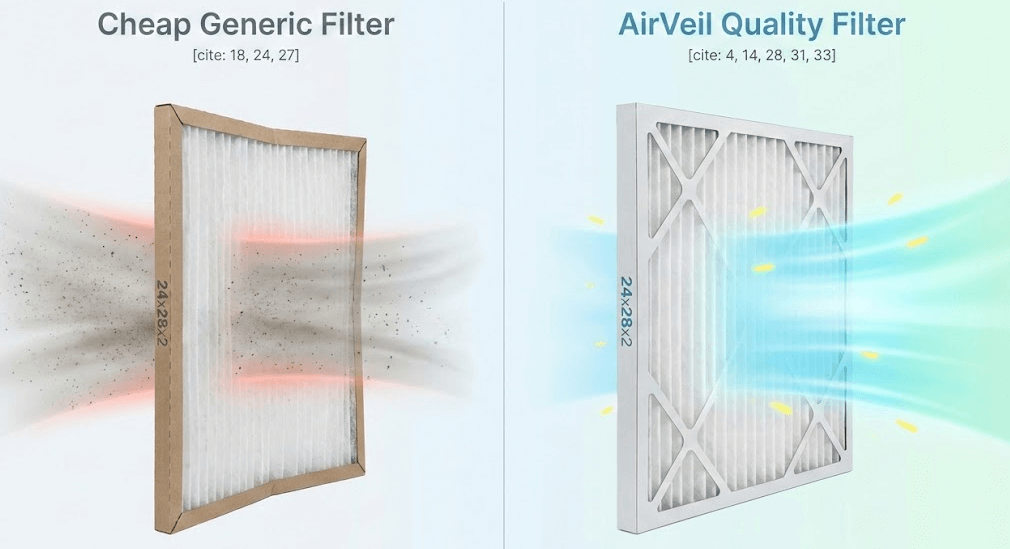
A 24x28x2 air filter isn’t something you’ll find at your local store — and when you finally locate one online, the price differences can be confusing. Our team of certified HVAC professionals has tested and installed enough budget filters in uncommon sizes to know this: the cheapest option almost always costs more in the long run. We’ve seen firsthand how poorly constructed filter media leads to restricted airflow, faster clogging, and filtration ratings that fall short under real conditions. As air quality-first specialists who work with hard-to-find sizes every day, we built this guide to help you tell the difference between a low price and real value — so you can protect both your system and the air your family breathes.
TL;DR Quick Answers
24x28x2 Air Filter
The 24x28x2 air filter is an uncommon residential size not typically stocked in retail stores. Here is what our certified HVAC professionals recommend you know before ordering:
- Size type. Specialty or hard-to-find. Not a standard retail dimension.
- Where to buy. Online retailers and specialty filter suppliers. Availability is limited compared to common sizes like20 by 25.
- Nominal vs. actual sizing. The 24x28x2 is the nominal size. Actual dimensions are typically a quarter to half inch smaller. Measure your filter slot before ordering.
- Recommended MERV range. MERV 8 through MERV 13 for most residential systems. Verify your system’s airflow capacity before selecting MERV 13.
- Filter depth advantage. A two-inch depth provides more media surface area than a one-inch filter. This means better particle capture and a longer usable service life.
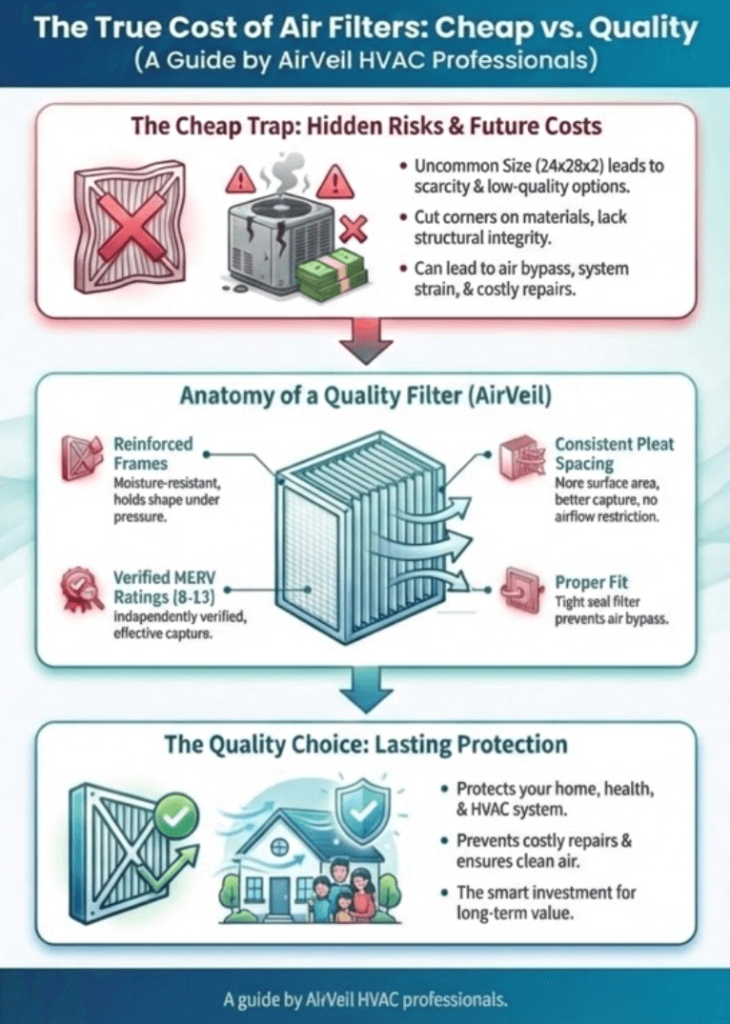
- What to look for. Reinforced frame construction, consistent pleat spacing, and an independently verified MERV rating.
- What to avoid. Budget filters with thin cardboard frames, loosely spaced pleats, and self-reported ratings. Based on our experience, these fail faster and cost more over time.
At AirVeil HVAC, we specialize in hard-to-find sizes like the 24x28x2. Our air quality-first approach ensures every recommendation is backed by field experience and trusted industry data.
Top Takeaways
- Cheap filters cost more in the long run. Budget 24x28x2s clog faster and restrict airflow sooner. A dirty filter can increase energy consumption by up to fifteen percent. The few dollars saved at purchase do not offset the ongoing cost.
- Uncommon sizes attract lower-quality manufacturers. Most reputable brands do not produce the 24x28x2 at scale. Discount manufacturers fill the gap — meeting the size requirement but cutting corners on materials and construction.
- Frame integrity determines filter performance. More budget filters fail from warped or collapsed frames than any other cause. A filter that cannot hold its shape cannot seal. Unfiltered air bypasses the media entirely.
- Your filter protects your home’s largest energy system. Heating and cooling accounts for nearly half of household energy use. A failing filter strains that system every day — driving up utility bills month after month.
- A few dollars more per replacement is not an upgrade — it is a necessity. A quality 24x28x2 air filter with a reinforced frame, consistent pleat spacing, and a verified MERV rating does the job from install to replacement. That is real value.
Table of Contents
Why 24x28x2s Are Hard to Find
The 24x28x2 is not a standard retail size. Most big-box stores carry common dimensions like20 by 25 or sixteen by twenty, which means homeowners with this uncommon size are often left searching online with limited options. That scarcity creates a marketplace where lower-quality manufacturers fill the gap with budget filters that meet the size requirement but cut corners on materials and construction. Based on our experience, this is where most filtration problems begin — not with the size itself, but with settling for whatever is available.
What Makes a Cheap Air Filter “Cheap”
Not all 24x28x2s are built the same, even when they share the same MERV rating on the label. Budget filters typically use thinner, lower-density media that allows more particles to pass through. The frames are often made from lightweight cardboard that warps under humidity or fails to seal properly inside the filter slot. Our team has pulled discount filters after just two weeks of use that were already bowing inward — a clear sign of structural failure that allows unfiltered air to bypass the media entirely. A printed MERV rating means very little if the filter cannot maintain its shape and seal throughout its service life.
The Real Cost of Going With the Lowest Price
A budget 24x28x2 air filter might save you a few dollars upfront, but the hidden costs add up quickly. Restricted airflow from low-quality media forces your HVAC system to work harder, increasing energy consumption and accelerating wear on critical components like the blower motor. We’ve seen firsthand how homeowners who consistently buy the cheapest available filter end up facing repair bills that far exceed what they saved. Clogged or collapsed filters also allow dust and allergens to circulate freely through the home, undermining the very purpose of having a filter in the first place.
How to Identify a Quality Filter in an Uncommon Size
When shopping for a 24x28x2, a few key indicators separate a reliable product from a disposable one. Look for filters with reinforced frames — either a moisture-resistant cardboard or a beverage board frame that holds its shape over time. Check that the MERV rating is independently verified, not just self-reported by the manufacturer. Our team recommends choosing a filter with consistent pleat spacing, as tightly and evenly pleated media provides more surface area for particle capture without restricting airflow. These details matter even more in uncommon sizes where aftermarket quality varies widely.
What MERV Rating Works Best for This Size
For a two-inch-deep filter in the twenty-four by twenty-eight dimension, a MERV 8 through MERV 13 range covers most residential needs effectively. A MERV 8 handles standard dust, pollen, and debris, while a MERV 13 captures finer particles like mold spores, pet dander, and some bacteria. However, our certified HVAC professionals caution against jumping to the highest rating without verifying your system can handle it. Some older or lower-capacity systems may experience airflow restriction with a MERV 13 filter, which defeats the purpose of better filtration. When in doubt, check your system’s specifications or consult a professional before upgrading.
Why Spending a Little More Pays Off Long-Term
A quality 24x28x2 typically costs only a few dollars more per replacement than a budget option — but the performance difference is significant. Better media captures more particles without choking airflow, which means your system runs efficiently and your filter lasts its full recommended lifespan. Based on our experience working with uncommon sizes, homeowners who invest in a properly constructed filter spend less on energy, less on repairs, and far less time worrying about indoor air quality. The best value is not the lowest price on the shelf. It is the filter that does its job correctly from the day you install it to the day you replace it.
“We’ve tested budget filters in uncommon sizes like the 24x28x2, and the pattern is always the same — the frame warps, the media collapses, and unfiltered air ends up right back in your living space. A filter that can’t hold its shape can’t protect your system or your air, no matter what the rating on the box says.”
Essential Resources Every 24x28x2 Air Filter Buyer Needs
We know from experience that finding a 24x28x2 air filter is only half the challenge. Making sure you choose the right one — for your system, your air quality, and your budget — requires reliable information. Our team of certified HVAC professionals has curated these authoritative resources to help you make a confident, informed decision on a size most retailers do not carry.
1. Understand What MERV Ratings Actually Measure — ASHRAE Filtration Standards
Our certified HVAC professionals reference ASHRAE standards daily. We have seen firsthand how a MERV rating printed on a box can mislead homeowners when the filter media cannot sustain that rating under real-world conditions. This resource explains how filters are tested and what each MERV level truly captures.
https://www.ashrae.org/technical-resources/filtration-and-disinfection-faq
2. Protect Your Respiratory Health With Better Filtration — American Lung Association
Cleaner air is at the core of everything we do at AirVeil HVAC. The American Lung Association explains how HVAC filters reduce indoor exposure to allergens, particulate matter, and airborne pollutants — a concern we take seriously, especially when homeowners are forced to settle for the only budget filter available in an uncommon size.
https://www.lung.org/clean-air/indoor-air/protecting-from-air-pollution/air-cleaning
3. Verify Your System Can Handle a Higher MERV Rating — Building America Solution Center
Our team recommends this resource before any homeowner upgrades to a MERV 13 filter in an uncommon size like the 24x28x2. We have seen systems struggle with higher-rated filters that were not matched to the equipment’s airflow capacity. This guide explains the relationship between MERV ratings, pressure drop, and system compatibility so you can upgrade with confidence. Pacific Northwest National Laboratory, U.S. Department of Energy
https://basc.pnnl.gov/resource-guides/high-merv-filters
Supporting Statistics on “24x28x2 Air Filter”
Our certified HVAC professionals back every recommendation with field experience and trusted data. These three statistics from leading U.S. authorities align directly with what we see during service calls on uncommon filter sizes like the 24x28x2.
1. Cheap Filters Clog Faster — Costing You Up to 15% More in Energy
The U.S. Department of Energy confirms a dirty filter can increase energy consumption by up to fifteen percent.
Here is what we see in the field with budget 24x28x2s:
- Lower-density media traps less and saturates faster
- Systems start working harder within weeks, not months
- Collapsed filters force HVAC equipment to run overtime
- The Department of Energy’s fifteen percent figure is conservative based on our experience
https://www.energy.gov/energysaver/air-conditioner-maintenance
2. You Breathe Indoor Air 90% of the Time — Filter Quality Is Not Optional
The U.S. Environmental Protection Agency estimates most Americans spend about ninety percent of their time indoors, where some pollutant levels can exceed outdoor concentrations.
For homeowners with uncommon sizes, this creates a real problem:
- Fewer filter options lead to settling for whatever ships fastest
- Budget filters degrade quickly and stop capturing particles effectively
- Dust accumulates on surfaces that should stay clean
- Ninety percent of your day is spent breathing air that passes through that filter
A filter that just fits the slot is not enough. It needs to perform.
https://www.epa.gov/indoor-air-quality-iaq/inside-story-guide-indoor-air-quality
3. Your Filter Guards the System That Uses Nearly Half Your Home’s Energy
ENERGY STAR reports that heating and cooling accounts for close to half of all household energy consumption.
Our team sees a clear pattern in homes using discount 24x28x2s:
- Weak frames warp under normal operating conditions
- Restricted airflow forces the system to run longer cycles
- Utility bills climb steadily over consecutive replacement periods
- Costs level off once a properly constructed filter is installed
Protecting the system responsible for nearly fifty percent of your energy use starts with a filter that performs — not just one that fits.
https://www.energystar.gov/saveathome/heating-cooling
Final Thought & Opinion on “Are Cheap 24x28x2 Air Filters Worth It?”
After working with uncommon filter sizes for years, our certified HVAC professionals have formed a clear opinion on this topic — and it goes beyond what the data alone can tell you.
What the Evidence Confirms
- Budget filters clog faster, restrict airflow sooner, and cost more in energy over time
- A dirty filter can increase system energy consumption by up to fifteen percent
- Your HVAC system accounts for nearly half your home’s total energy use
- You and your family spend roughly ninety percent of your time breathing indoor air
- Weak frames and low-density media fail under real-world conditions
These are documented by the U.S. Department of Energy, the EPA, and ENERGY STAR — and they match what we see on every service call involving a budget filter in an uncommon size.
Our Professional Opinion
Here is where our perspective differs from most generic advice online.
The 24x28x2 is not a commodity size. It is a specialty size. Specialty sizes attract a different marketplace — one where low-quality manufacturers fill the gap because reputable brands do not always produce uncommon dimensions at scale.
That means the quality floor for this size is lower than what you would find shopping for a standard 20 by 25.
We see the same pattern repeat:
- A homeowner finds the cheapest 24x28x2 online
- The filter arrives with thin media, a lightweight frame, and an acceptable-looking MERV rating
- Within two to three weeks the frame bows inward and unfiltered air bypasses the media
- Dust accumulates on vents and surfaces before the homeowner notices
- By the time they call for service the system has been running overtime and the evaporator coil is coated with debris
This is not a rare scenario. It is the most common pattern we encounter with budget filters in hard-to-find sizes.
What We Believe Sets Quality Apart
Based on firsthand experience, the difference between a cheap and quality 24x28x2 comes down to three things:
- Frame integrity. A reinforced or beverage board frame holds its shape under airflow pressure. A thin cardboard frame does not. This single factor determines whether your filter seals and performs or simply occupies the slot.
- Media density and pleat consistency. Evenly spaced, tightly constructed pleats create more surface area for particle capture without choking airflow. Budget filters cut corners here first — and it shows within weeks.
- Verified ratings under real conditions. A MERV rating is only meaningful if the filter sustains it throughout its service life. We have tested budget filters that start at their rated performance and drop significantly once the media sags or compresses.
Frequently Asked Questions About “Are Cheap 24x28x2 Air Filters Worth It?”
Q: Is a cheap 24x28x2 air filter good enough for my home?
A: In our experience, no. We have pulled budget filters after just two to three weeks that were already bowing inward. A cheap filter may fit the slot — but fitting and performing are two different things.
Budget filters typically fail because of:
- Lower-density media that saturates quickly
- Lightweight frames that warp under normal airflow
- Filtration performance that drops well before the replacement date
Q: Why are 24x28x2s so hard to find in stores?
A: This is not a standard retail size. Most stores stock common dimensions like20 by 25 or 16 by 25. That scarcity creates problems:
- Homeowners are limited to online-only options
- Quality varies significantly from seller to seller
- Discount manufacturers fill the gap with inferior products
- Fewer choices means less competition on quality
Q: How can I tell if a budget filter is actually low quality?
A: Our team evaluates every filter using three criteria:
- Frame construction. A thin cardboard frame that flexes under hand pressure will not survive sustained airflow. Quality filters use reinforced or beverage board frames.
- Pleat spacing. Uneven or loosely spaced pleats indicate lower media density. Consistent, tight pleats provide more surface area and better capture.
- Rating verification. A printed MERV number means little if it is self-reported. Look for independently tested and verified ratings.
Q: Will a cheap filter damage my HVAC system?
A: It can. We have seen it happen repeatedly. Here is the typical sequence:
- A budget filter clogs prematurely or collapses inward
- Airflow drops and the system compensates by running longer
- Critical components like the blower motor wear down faster
- The homeowner faces a repair bill that far exceeds the cost of a quality air filter
We have responded to service calls where the root cause traced directly back to a failed discount filter that had been in place for less than a month.
Q: What MERV rating should I choose for a 24x28x2?
A: Our team recommends a MERV rating between eight and thirteen for most homes.
- MERV 8. Handles standard dust, pollen, and debris effectively.
- MERV 13. Captures finer particles like mold spores, pet dander, and some bacteria.
One important caution from our field experience — do not jump to the highest rating without verifying your system can handle the added resistance. Some older or lower-capacity systems struggle with a MERV 13. That defeats the purpose of upgrading.
Q: Is it worth paying more for a quality 24x28x2s?
A: Based on everything we have seen, absolutely. The price difference is typically only a few dollars per replacement. The performance gap is significant.
Homeowners who switch from budget to quality filters consistently report:
- Steadier energy bills
- Cleaner vents and surfaces
- Fewer service calls
- Filters that last their full rated service life
That is not just a better air filter. That is a better value.
Stop Settling for Cheap 24x28x2 Air Filters That Cost You More in the Long Run
Get the right 24x28x2 air filter backed by certified HVAC professionals who specialize in hard-to-find sizes — contact AirVeil HVAC today for an air quality-first recommendation you can trust. Your system, your energy bills, and the air your family breathes deserve better than the cheapest option on the shelf.