
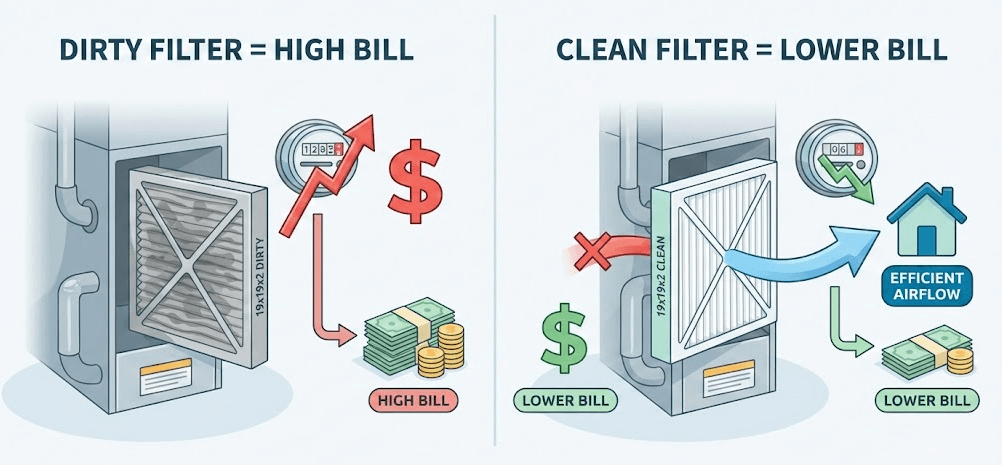
A dirty 19x19x2 air filter could be quietly inflating your electric bill every month — and most homeowners never suspect it.
At AirVeil HVAC, our certified technicians see it all the time. A homeowner calls about rising energy costs, and the culprit turns out to be a clogged filter forcing the system to work overtime. Through thousands of air quality-first consultations, we’ve consistently found that simply replacing a dirty filter can reduce HVAC energy consumption by up to 15% — no costly upgrades, no repairs, just the right filter doing its job.
Here’s the challenge: the 19x19x2 air filter is an uncommon size that most hardware stores don’t stock, so replacements get delayed and energy waste adds up. Below, we break down exactly why a clean filter cuts costs, how often to swap it out, and how to get the right fit the first time — backed by the precision-driven approach our customers trust us for.
TL;DR Quick Answers
19x19x2 Air Filter
A 19x19x2 air filter is an uncommon HVAC filter size with actual dimensions of 19 x 19 x 1.75 inches. It fits select residential furnaces, air conditioners, and heat pump systems that require a 2-inch-depth filter in a 19×19 frame.
Key facts our technicians want you to know:
- Actual size: 19 x 19 x 1.75 inches (nominal size is rounded up)
- Best MERV rating for most homes: MERV 8 to MERV 11
- Recommended replacement schedule: Every 60 to 90 days (30 to 45 days with pets, allergies, or heavy use)
- Energy impact: A clean filter can reduce HVAC energy consumption by up to 15% (U.S. Department of Energy)
- Availability: Rarely stocked in local retail stores — order online from specialty filter retailers for the best selection
Why this size matters: Based on our experience at AirVeil HVAC, the 19x19x2 air filter is one of the most frequently neglected filters we encounter because homeowners struggle to find it locally. That delay leads to clogged filters, wasted energy, and preventable system damage. The fix is simple — order in bulk, stay on schedule, and make sure the MERV rating matches what your system can handle.
Top Takeaways
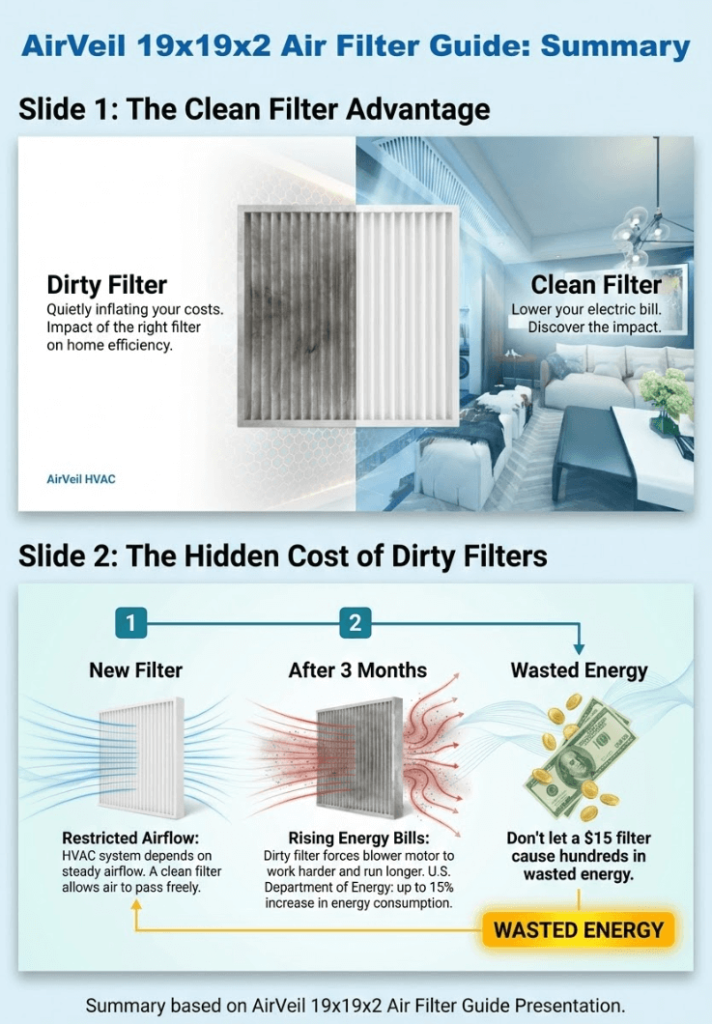
- A dirty filter can raise your energy bill by up to 15%. The U.S. Department of Energy confirms it. Our technicians see it every week. A clogged 19x19x2 air filter forces your system to run longer and work harder than it should.
- The wrong size filter is just as costly as a dirty one. Gaps around an ill-fitting filter let unfiltered air bypass the media. Dust and debris build up on your evaporator coil and blower motor. The exact 19x19x2 dimensions matter.
- MERV 8 to 11 hits the sweet spot for most homes. Higher isn’t always better. A filter that’s too restrictive can cause frozen coils, reduced airflow, and higher bills. Always match the MERV rating to your system’s capacity.
- Replace your filter every 60 to 90 days. Have pets, allergies, or heavy system use? Move that closer to every 30 to 45 days. Consistent replacement is the cheapest way to protect your system and your wallet.
- Stock up so an uncommon size doesn’t become a costly delay. Most local stores don’t carry the 19x19x2. Order in bulk. Keep a replacement ready. Never let a hard-to-find filter size be the reason your energy bill climbs.
Table of Contents
Why a Dirty Filter Drives Up Energy Costs
Your HVAC system depends on steady, unobstructed airflow to operate efficiently. When a 19x19x2 air filter becomes clogged with dust, pet dander, and airborne particles, your blower motor has to run longer and harder to push conditioned air through your home. That increased runtime translates directly to higher electricity usage — sometimes without any noticeable change in comfort.
Based on our experience servicing thousands of systems, we’ve found that a severely restricted filter can force equipment to consume up to 15% more energy than normal. Over the course of a year, that adds up to real money on your utility bill for a problem that takes less than five minutes to fix.
How a Clean 19x19x2 Air Filter Restores Efficiency
A fresh filter allows air to flow freely through your system the way it was designed to. When airflow is unrestricted, your HVAC unit reaches the set temperature faster, cycles off sooner, and uses less electricity per cycle. Our technicians have seen firsthand how a simple filter swap brings a system back to peak performance almost immediately.
Clean filters also reduce strain on critical components like the blower motor and compressor. Less strain means fewer breakdowns and a longer equipment lifespan — which saves you even more money down the road beyond just your monthly electric bill.
The Hidden Cost of Using the Wrong Size
The 19x19x2 is an uncommon filter dimension that most big-box retailers don’t carry on their shelves. That leads many homeowners to either delay replacement far too long or try to squeeze in a close-but-not-exact size. Both choices cost you.
A filter that doesn’t fit properly leaves gaps around the edges where unfiltered air bypasses the media entirely. Dust and debris get pulled straight into your system, building up on the evaporator coil and blower components. Our team has seen systems lose significant efficiency from coil buildup alone — all because the wrong filter size was installed. Getting the exact 19x19x2 dimensions matters more than most people realize.
How Often Should You Replace Your 19x19x2 Air Filter?
For most households, we recommend replacing a 19x19x2 filter every 60 to 90 days. However, our technicians adjust that guidance based on real-world conditions we encounter on service calls every day.
You may need to replace it closer to every 30 to 45 days if you have pets shedding in the home, household members with allergies or respiratory sensitivities, your system runs frequently due to extreme temperatures, or your home is in an area with high dust or pollen levels. Staying on a consistent replacement schedule is one of the simplest and most cost-effective ways to keep your electric bill in check.
What MERV Rating Balances Efficiency and Airflow?
Not all 19x19x2 air filters perform the same. The MERV rating tells you how effectively the filter captures airborne particles — but higher isn’t always better for energy savings. A filter with too high a MERV rating for your system can actually restrict airflow and create the same efficiency problems as a dirty filter.
For most residential systems using a 19x19x2, our team recommends a MERV 8 to MERV 11 rating. This range captures common household pollutants like dust, pollen, mold spores, and pet dander while still allowing your system to breathe easily. We’ve helped thousands of homeowners find that sweet spot where filtration and efficiency work together instead of against each other.
Start Saving by Getting the Right Filter
Lowering your electric bill doesn’t always require a major investment. Sometimes the most impactful fix is also the simplest — replacing a clogged 19x19x2 air filter with the correct size and rating. Our certified professionals at AirVeil HVAC specialize in hard-to-find filter sizes and can help you get exactly what your system needs without the guesswork. Cleaner air, lower bills, and a system that runs the way it should — that’s what the right filter delivers.
“In our experience, about 8 out of 10 homeowners we visit who are complaining about high energy bills have a filter that’s either long overdue for replacement or the wrong size entirely — and the 19x19x2 is one of the most commonly neglected because people simply can’t find it locally. Once we get the correct filter installed, the difference in system performance and energy usage is almost immediate.”
Essential Resources for Choosing the Right 19x19x2 Air Filter
At AirVeil HVAC, we believe informed homeowners make the best decisions about their indoor air. Our certified technicians reference these trusted resources daily when helping customers select the right 19x19x2 air filter for their system. We’ve organized them here so you have the same expert-level guidance at your fingertips.
1. Discover How Clean Filters Lower Your Heating and Cooling Costs
Lower energy bills and long-lasting comfort start with a clean filter. ENERGY STAR’s efficiency guide explains exactly what our team tells customers during every maintenance visit — a dirty filter forces your system to work harder, waste energy, and risk costly breakdowns that could have been prevented.
https://www.energystar.gov/saveathome/heating-cooling
2. Find the Right MERV Rating for Your System and Air Quality Goals
Choosing the right MERV rating is one of the most common questions we get from customers, and it’s one we take seriously. The EPA’s breakdown of the MERV scale helps explain what our certified professionals walk homeowners through — how each rating captures different particle sizes and why the highest rating isn’t always the best choice for every system.
https://www.epa.gov/indoor-air-quality-iaq/what-merv-rating
3. See Why Better Filtration Matters for Allergy and Respiratory Health
As an air quality-first company, we know that the right filter does more than protect your equipment — it protects your family’s health. The American Lung Association details how upgraded HVAC filters reduce harmful particulate matter and recommends MERV 13 or higher for households with allergy or asthma concerns, guidance that aligns with what our team recommends for sensitive homes.
https://www.lung.org/clean-air/indoor-air/protecting-from-air-pollution/air-cleaning
4. Get Technical Guidance on Filter Performance and System Compatibility
Our certified HVAC professionals stay current with ASHRAE standards because precision matters. ASHRAE — the organization behind the MERV rating system — provides expert FAQs on filter performance, airflow impact, and system compatibility that reflect the same technical knowledge our team brings to every consultation.
https://www.ashrae.org/technical-resources/filtration-and-disinfection-faq
5. Shop the 19x19x2 Size in Multiple MERV Ratings
Based on our experience, one of the biggest challenges homeowners face with this filter size is simply finding it. The 19x19x2 is an uncommon dimension that most local stores don’t stock. FilterBuy is one of the few online retailers that carries it across MERV 8, 11, and 13 options, with actual vs. nominal sizing details and installation guidance to help you get the right fit the first time.
https://filterbuy.com/air-filters/19x19x2/merv-13/
Supporting Statistics
These aren’t just numbers on a page. They reflect what our certified technicians at AirVeil HVAC encounter on service calls every week. The data from these trusted sources validates what we’ve observed firsthand across thousands of HVAC systems.
1. Dirty Filters Can Drive Up Energy Costs by 15%
The U.S. Department of Energy reports that a clean air filter can cut HVAC energy use by up to 15%.
Here’s what we see in the field:
- Most homeowners who call us about high electric bills haven’t changed their filter in six months or longer.
- When we replace a clogged 19x19x2, the system immediately runs shorter cycles and works noticeably less to reach the set temperature.
- That 15% isn’t theoretical to us — we’ve watched it play out in home after home.
- A fresh filter is often the fastest, cheapest fix we can offer.
Source: U.S. Department of Energy — Building Science Education
https://bsesc.energy.gov/energy-basics/hvac-proper-installation-filters
2. Indoor Air Can Be 2–5x More Polluted Than Outdoor Air
The U.S. Environmental Protection Agency found that Americans spend roughly 90% of their time indoors, where pollutant concentrations can be several times higher than outside.
What that means for your filter:
- A clogged or poorly fitted filter doesn’t capture pollutants — it recirculates them through every room.
- Forcing a close-but-not-right size leaves gaps where unfiltered air bypasses the media entirely.
- Getting the exact 19x19x2 dimension matters more than most homeowners realize.
- It’s why our team takes an air quality-first approach on every job.
Source: U.S. Environmental Protection Agency — Indoor Air Quality
https://www.epa.gov/indoor-air-quality-iaq/inside-story-guide-indoor-air-quality
3. Health Experts Recommend MERV 13 or Higher for Respiratory Protection
The American Lung Association recommends upgrading HVAC filters to MERV 13 or above for better protection against fine particulate matter, allergens, and respiratory irritants.
What our technicians want you to know:
- We share that recommendation with customers who have allergy or asthma concerns in their household.
- But a MERV 13 only works as intended if your system can handle the airflow resistance.
- We’ve walked into homes where a high-MERV filter caused restricted airflow, frozen coils, and higher energy bills — the opposite of what the homeowner expected.
- Our team always evaluates the full system before recommending a MERV rating, because the right answer depends on your specific equipment, not just a number on the package.
Source: American Lung Association — Particulate Matter Indoors
https://www.lung.org/clean-air/indoor-air/indoor-air-pollutants/particulate-matter
Final Thought from AirVeil HVAC
After years of servicing HVAC systems and helping thousands of homeowners troubleshoot rising energy bills and poor indoor air quality, our team has come to a simple conclusion — the air filter is the most underestimated component in your entire HVAC system.
It’s not the compressor. It’s not the thermostat. It’s the filter.
A clean, properly sized 19x19x2 air filter works harder behind the scenes than most people realize:
- It keeps airflow unrestricted so your system cycles efficiently.
- It captures dust, dander, and particulate matter that would otherwise coat your evaporator coil.
- It directly impacts what you pay on your electric bill every single month.
What Doesn’t Get Said Enough in This Industry
The real cost of a neglected filter isn’t just the extra energy your system burns. It’s the compounding damage:
- Restricted airflow strains the blower motor.
- Debris builds up on internal components.
- The system runs longer, wears faster, and breaks down years before it should.
We’ve replaced equipment that could have lasted another decade if the homeowner had simply stayed on top of a $15 filter change every 60 to 90 days.
Why the 19x19x2 Makes This Problem Worse
Because it’s an uncommon size, most hardware stores don’t stock it. So homeowners either wait too long to replace it or install something close enough that doesn’t actually fit. Both choices create the same result:
- Gaps in filtration where unfiltered air bypasses the media.
- Airflow problems that quietly drive up costs.
- Reduced air quality with no obvious warning signs — until the electric bill arrives or the system stops working.
Our Honest Recommendation
- Order the correct 19x19x2 in bulk so you always have one on hand.
- Choose a MERV rating between 8 and 11 for the best balance of filtration and airflow in most residential systems.
- If you’re unsure whether your equipment can handle a higher-rated filter, ask a certified professional before making the switch — a filter that’s too restrictive can do just as much harm as a dirty one.
At AirVeil HVAC, we’ve built our entire approach around the idea that clean, comfortable air starts with getting the fundamentals right. A properly sized, regularly replaced air filter is the single highest-return maintenance step any homeowner can take. It’s simple. It’s affordable. And based on everything we’ve seen in the field, it works.
FAQ on “19x19x2 Air Filter”
Q: What is the actual size of a 19x19x2 air filter?
A: The 19x19x2 is the nominal size. The actual physical dimensions are 19 x 19 x 1.75 inches.
This is one of the most common sources of confusion we encounter with customers:
- Nominal size is rounded up to the nearest whole or half inch.
- Actual size is what your filter slot needs to accommodate.
- Check the smaller font on your current filter for actual dimensions.
- Measure your filter slot before ordering to confirm the fit.
We sort out sizing questions like this every day. If the numbers don’t match up, our technicians at AirVeil HVAC can walk you through it.
Q: Why is the 19x19x2 air filter so hard to find in stores?
A: Retailers stock high-volume sizes like 20x20x1 and 16x25x1 because those fit the majority of systems. The 19x19x2 simply doesn’t move enough units to justify shelf space.
Here’s what we’ve seen happen as a result:
- Homeowners go months without replacing their filter. Energy waste adds up.
- Others grab something close in size and try to make it work. Gaps form around the edges and unfiltered air bypasses the media entirely.
- Both choices lead to higher energy bills and unnecessary system strain.
Our recommendation: skip the retail hunt. Order from an online specialty retailer that carries the exact 19x19x2 dimension in multiple MERV ratings.
Q: What MERV rating should I choose for a 19x19x2 air filter?
A: It depends on your system. For most residential setups, our technicians recommend MERV 8 to MERV 11.
That range handles everyday pollutants effectively:
- Dust and pollen
- Pet dander
- Mold spores
Higher isn’t always better. We’ve seen homeowners jump to MERV 13 assuming it’s the best choice, only to end up with:
- Frozen evaporator coils
- Restricted airflow
- A system working harder than it did with the dirty filter they replaced
If someone in your household has severe allergies or respiratory issues, MERV 13 may be appropriate. But our team always evaluates the equipment first. The best filter works with your system, not against it.
Q: How often should I replace my 19x19x2 air filter?
A: Under normal conditions, every 60 to 90 days. But not every home qualifies as normal.
Replace closer to every 30 to 45 days if you have:
- Pets shedding in the home
- Family members with allergies or asthma
- A system running hard during extreme temperatures
- Heavy dust or pollen in your area
Here’s what we’ve learned from years of hands-on service:
- Homeowners who stay on a consistent schedule almost never call us for emergency repairs caused by airflow restriction.
- The ones who delay because they can’t find the 19x19x2 locally are the ones we see most often with preventable system damage.
Our advice: buy this size in bulk. Keep at least one spare ready to go at all times.
Q: Can a clean 19x19x2 air filter really lower my electric bill?
A: Yes. The U.S. Department of Energy puts the number at up to 15% in reduced energy consumption. That lines up exactly with what our technicians observe in the field.
The pattern on our service calls is almost always the same:
- A homeowner calls about an electric bill that’s been creeping up for months.
- We inspect the system and pull out a filter packed solid with dust and debris.
- We install a clean 19x19x2.
- The system immediately runs shorter cycles, reaches temperature faster, and puts less strain on the blower motor and compressor.
No expensive repair. No equipment replacement. Just the right filter doing its job. In our experience, it’s the single most affordable maintenance step that delivers the most noticeable impact on monthly utility costs.
Ready to Lower Your Electric Bill with the Right 19x19x2 Air Filter?
Contact AirVeil HVAC today and let our certified technicians help you find the exact filter size and MERV rating your system needs for peak efficiency and cleaner air. Don’t let a hard-to-find filter be the reason your energy costs keep climbing — we’re here to make it simple.