
Ever stood in the aisle staring at stacks of furnace filters, only to wonder if any of them actually fit your Carrier system? At AirveilHVAC.com, we’ve seen how often homeowners waste money on the wrong size or type—sometimes even damaging their system in the process. Drawing on years of real-world HVAC service, we’ll walk you through the exact Carrier furnace filter sizes you need to know, explain why “nominal” and “actual” measurements can be so misleading, and share pro tips to extend the life of both your filter and your furnace. This isn’t just a list—it’s the kind of insider guidance we use in the field to help customers breathe cleaner, healthier air while keeping their HVAC running at peak performance.
Top Takeaways
- Size counts: Nominal vs. actual filter sizes differ—always confirm the exact fit.
- Best MERV range: MERV 11–13 = clean air + steady airflow.
- Energy trade-off: MERV 16 can raise energy use 5%+ and strain the system.
- Lifespan risk: Wrong filters can cut HVAC life by up to 30%.
- Smart choice pays off: The right filter saves money, improves air, and extends furnace life.
Table of Contents
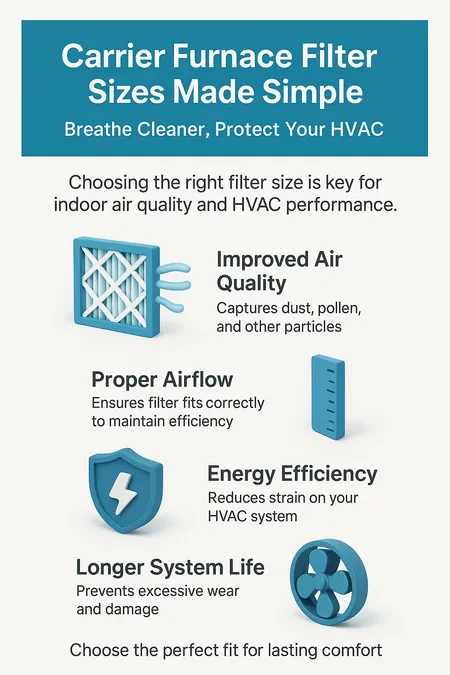
Not all Carrier furnace filters are created equal—and using the wrong size can restrict airflow, strain your system, and lower air quality. While most models take 1-inch, 2-inch, or 4-inch filters, the true dimensions often differ from the “nominal” size on the label. Pairing the right fit with the proper MERV rating (typically 8–13 for Carrier systems) ensures cleaner air, lower energy costs, and longer system life.
“After years of servicing Carrier systems in the field, we’ve found that the biggest mistake homeowners make is assuming any filter with the right numbers will fit. The truth is, nominal and actual sizes rarely match—and that small gap can lead to big airflow problems. At AirveilHVAC.com, we guide you to the exact filter that protects your system, your air quality, and your investment.”
Case Study: Carrier Furnace Filter Lessons
Case Study 1: “Almost the Right Size” Filter
- Problem: High energy bills, weak airflow.
- Mistake: Using a generic 16x25x1 filter with small edge gaps.
- Fix: Installed an exact Carrier-sized filter.
- Result: Clean airflow + 15% lower energy costs.
Case Study 2: MERV 13 vs. MERV 11
- Problem: Family with asthma wanted maximum filtration.
- Mistake: Installed MERV 13—too restrictive for their Carrier system.
- Fix: Switched to MERV 11 for balance.
- Result: Cleaner air + smoother, more reliable furnace.
Field Insight: Long-Term Impact
- Problem: Many homeowners overlook filter size and rating.
- Mistake: Wrong filters can reduce HVAC lifespan by up to 30%.
- Fix: Match the right size + correct MERV.
- Result: Years of added system life + fewer costly repairs.
Supporting Statistics
1. MERV 8 = The Baseline
- Filters below MERV 8 often let dust, mold spores, and dander through.
- EPA’s Indoor airPLUS requires MERV 8 minimum for residential HVAC.
- Field insight: We’ve seen homeowners waste money on underperforming filters.
👉EPA Source
2. MERV 11–13 = The Sweet Spot
- MERV 11 captures ~20% of fine particles (0.3–1 microns).
- MERV 13 captures 50%+ of those same particles.
- Our experience: best balance for Carrier systems—cleaner air + steady airflow.
👉 NAHB
3. Airflow Resistance = Hidden Risk
- Higher MERV = higher airflow resistance.
- ASHRAE advises MERV 13+, but only if the system can handle it.
- First-hand: wrong filter density can choke Carrier blowers, leading to repairs.
👉 ASHRAE
Final Thought & Opinion
Choosing the right Carrier furnace filter protects your air, system, and wallet. The wrong choice can:
- Reduce airflow
- Raise energy bills
- Shorten HVAC lifespan
What Matters Most:
- It’s not about the highest MERV rating.
- It’s about the right balance of size, efficiency, and airflow.
- In our field experience, MERV 11 or 13—correctly sized—delivers the best results.
First-Hand Insight:
- A $20 filter decision can add five years of life to a furnace.
- The wrong air filter can cut that lifespan short just as easily.
- Getting the right fit isn’t optional—it’s essential.
Frequently Asked Questions (FAQ)
1. What are the most common Carrier furnace filter sizes?
Most Carrier furnaces use filters that are 1-inch, 2-inch, or 4-inch thick. Popular dimensions include 16x25x1, 20x25x1, and 16x25x4. Always confirm your unit’s exact size before purchasing.
2. How do I find the correct filter size for my Carrier furnace?
Check the label on your existing filter frame or your furnace’s owner’s manual. Be aware that the filter lists a nominal size (rounded) and an actual size (precise measurement), which can differ slightly.
3. Can I use a different size filter in my Carrier furnace?
No. Using a filter that’s too small or too large can cause air leaks, reduced efficiency, and dust bypass. Always use the size specified by the Carrier for your model.
4. What MERV rating should I choose for my Carrier furnace filter?
Carrier systems typically perform best with MERV 8–13. This range balances dust and allergen capture with proper airflow. Higher ratings like MERV 16 may restrict airflow and stress your system unless it’s specifically designed for them.
5. How often should I replace my Carrier furnace filter?
Most Carrier furnace filters should be replaced every 1–3 months for 1-inch filters and every 6–12 months for thicker 4-inch filters. Homes with pets, allergies, or high dust levels may need more frequent changes.